When Was the First Exhibition of Quilt Art Shown
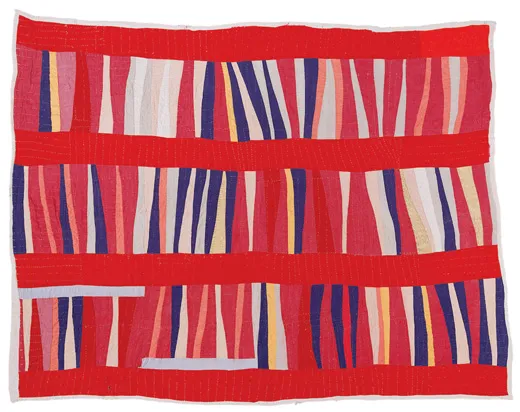
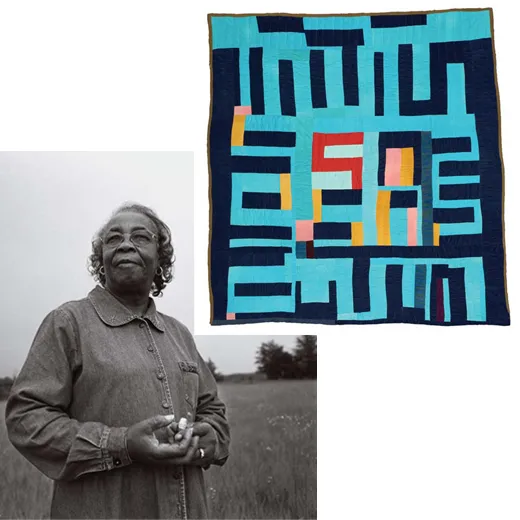

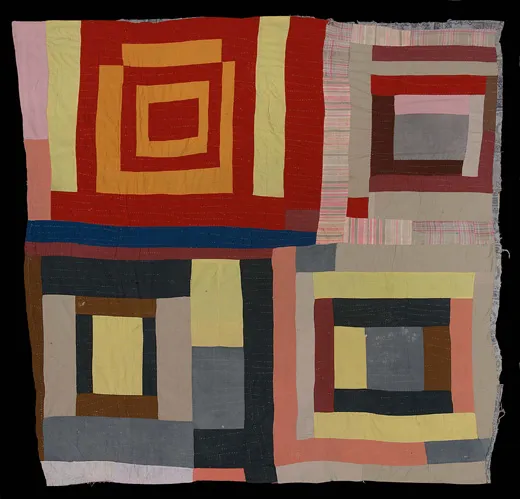
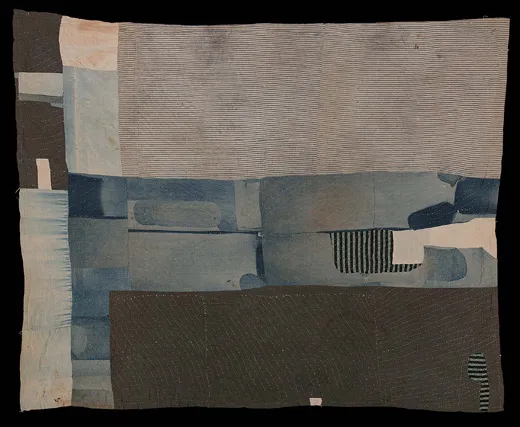
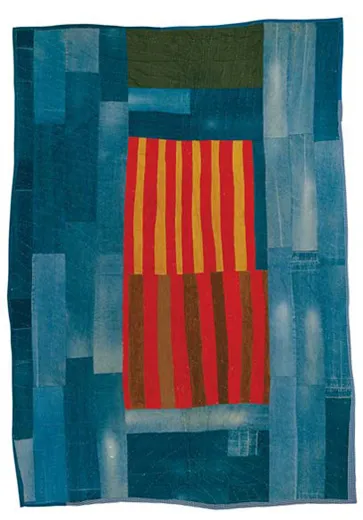
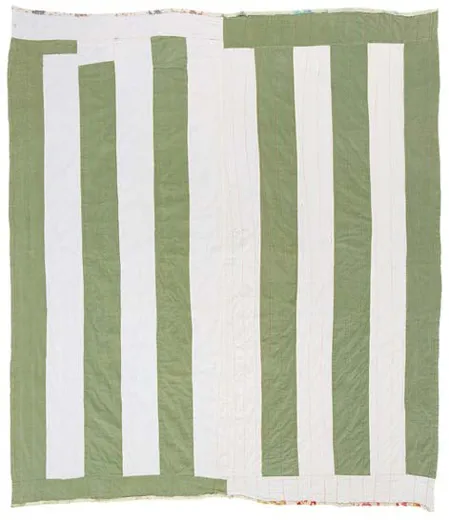
Annie Mae Young is looking at a photograph of a quilt she pieced together out of strips torn from well-worn cotton shirts and polyester pants. "I was doing this quilt at the time of the civil rights movement," she says, contemplating its jazzy, free-course squares.
Martin Luther King Jr. came to Young's hometown of Gee'south Bend, Alabama, around that time. "I came over here to Gee's Bend to tell you, You are somebody," he shouted over a heavy pelting late one wintertime night in 1965. A few days later, Young and many of her friends took off their aprons, laid downward their hoes and rode over to the county seat of Camden, where they gathered outside the erstwhile jailhouse.
"We were waiting for Martin Luther King, and when he drove up, we were all slappin' and singin'," Young, 78, tells me when I visit Gee'southward Curve, a small rural community on a peninsula at a deep bend in the Alabama River. Wearing a red turban and an apron bright with pink peaches and yellow grapes, she stands in the doorway of her brick bungalow at the end of a dirt road. Swaying to a rhythm that virtually everyone in town knows from a lifetime of churchgoing, she breaks into song: "We shall overcome, we shall overcome...."
"Nosotros were all merely happy to see him coming," she says. "Then he stood out there on the ground, and he was talking virtually how we should wait on a motorbus to come and we were all going to march. We got loaded on the autobus, but we didn't get a hazard to practise information technology, 'cause nosotros got put in jail," she says.
Many who marched or registered to vote in rural Alabama in the 1960s lost their jobs. Some fifty-fifty lost their homes. And the residents of Gee'due south Bend, sixty miles southwest of Montgomery, lost the ferry that connected them to Camden and a direct route to the outside globe. "We didn't close the ferry because they were blackness," Sheriff Lummie Jenkins reportedly said at the time. "Nosotros closed it because they forgot they were black."
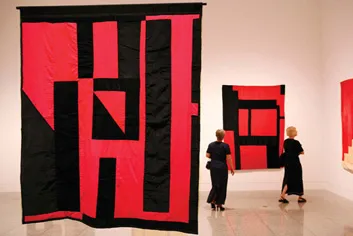
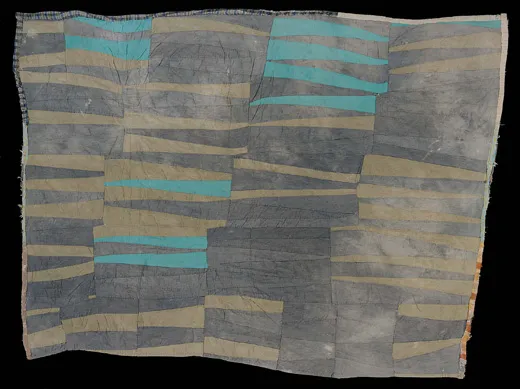
Half-dozen of Immature'south quilts, together with 64 past other Gee's Bend residents, have been traveling around the United states of america in an exhibition that has transformed the style many people think virtually art. Gee's Bend'south "eye-poppingly gorgeous" quilts, wrote New York Times art critic Michael Kimmelman, "turn out to be some of the most miraculous works of modern art America has produced. Imagine Matisse and Klee (if yous remember I'm wildly exaggerating, see the show), arising not from rarefied Europe, merely from the caramel soil of the rural S." Curator Jane Livingston, who helped organize the exhibition with collector William Arnett and art historians John Beardsley and Alvia Wardlaw, said that the quilts "rank with the finest abstract art of any tradition." After stops in such cities as New York, Washington, D.C., Cleveland, Boston and Atlanta, "The Quilts of Gee'due south Bend" will end its tour at the Fine Arts Museums of San Francisco's de Young Museum December 31.
The bold drama of the quilt Immature was working on in 1965 is too constitute in a quilt she made out of work clothes eleven years afterward. The primal design of red and orange corduroy in that quilt suggests prison bars, and the faded denim that surrounds it could be a comment on the American dream. But Immature had more practical considerations. "When I put the quilt together," she says, "it wasn't large enough, and I had to get some more material and make it bigger, and then I had these old jeans to make information technology bigger."
Collector William Arnett was working on a history of African-American colloquial fine art in 1998 when he came across a photo of Young'south work-clothes quilt draped over a woodpile. He was and then knocked out by its originality, he set out to detect it. A couple of phone calls and some artistic enquiry later, he and his son Matt tracked Young downwardly to Gee'due south Curve, then showed up unannounced at her door belatedly one evening. Young had burned some quilts the week before (smoke from called-for cotton drives off mosquitoes), and at starting time she idea the quilt in the photograph had been amongst them. But the next day, after scouring closets and searching nether beds, she found information technology and offered it to Arnett for costless. Arnett, however, insisted on writing her a check for a few m dollars for that quilt and several others. (Young took the check straight to the banking company.) Soon the word spread through Gee'southward Bend that in that location was a crazy white man in town paying good money for raggedy one-time quilts.
When Arnett showed photos of the quilts made by Immature and other Gee's Benders to Peter Marzio, of the Museum of Fine Arts, Houston (MFAH), he was so impressed that he agreed to put on an exhibition. "The Quilts of Gee's Bend" opened in that location in September 2002.
The exhibition revived what had been a dying art in Gee's Curve. Some of the quilters, who had given in to age and arthritis, are now back quilting again. And many of their children and grandchildren, some of whom had moved away from Gee's Bend, have taken up quilting themselves. With the help of Arnett and the Tinwood Alliance (a nonprofit organization that he and his four sons formed in 2002), fifty local women founded the Gee's Bend Quilters Commonage in 2003 to market their quilts, some of which at present sell for more than than $twenty,000. (Function goes direct to the maker, the balance goes to the collective for expenses and distribution to the other members.)
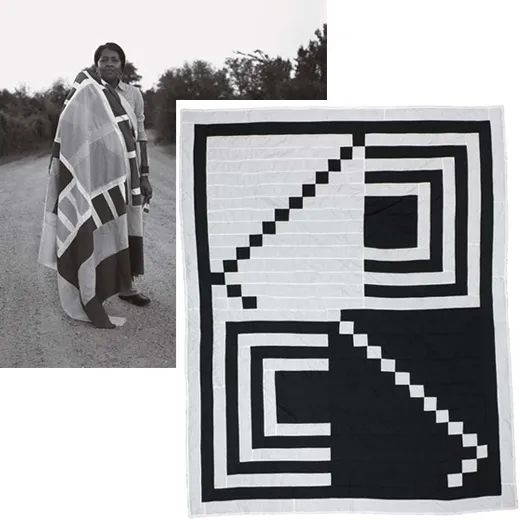
Now a 2nd exhibition, "Gee's Bend: The Architecture of the Quilt," has been organized by the MFAH and the Tinwood Alliance. The evidence, which opened in June, features newly discovered quilts from the 1930s to the 1980s, forth with more recent works by established quilters and the younger generation they inspired. The exhibition will travel to vii other venues, including the Indianapolis Museum of Art (Oct 8-Dec 31) and the Orlando Museum of Fine art (January 27-May thirteen, 2007).
Arlonzia Pettway lives in a not bad, recently renovated house off a road plagued with potholes. The road passes by cows and goats grazing outside robin's-egg blue and brown bungalows. "I remember some things, honey," Pettway, 83, told me. (Since my interview with her, Pettway suffered a stroke, from which she is nevertheless recovering.) "I came through a hard life. Maybe nosotros weren't bought and sold, but we were notwithstanding slaves until 20, 30 years agone. The white man would go to everybody'southward field and say, 'Why you not at work?'" She paused. "What do you remember a slave is?"
As a girl, Pettway would watch her grandmother, Sally, and her mother, Missouri, piecing quilts. And she would mind to their stories, many of them about Dinah Miller, who had been brought to the United States in a slave transport in 1859. "My great-grandmother Dinah was sold for a dime," Pettway said. "Her dad, blood brother and mother were sold to different people, and she didn't see them no more than. My bully-grandfather was a Cherokee Indian. Dinah was fabricated to slumber with this big Indian like you stud your cow.... You lot couldn't accept no skinny children working on your slave master'south farm." In addition to Pettway, some 20 other Gee's Bend quiltmakers are Dinah'due south descendants.
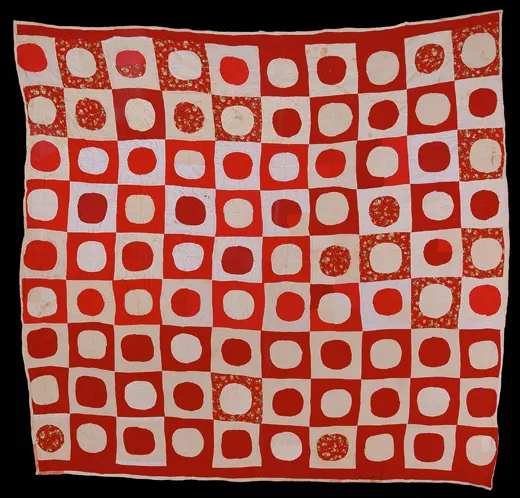
The quilting tradition in Gee'south Bend may become back as far as the early 1800s, when the customs was the site of a cotton plantation owned by a Joseph Gee. Influenced, perhaps, past the patterned textiles of Africa, the women slaves began piecing strips of cloth together to brand bedcovers. Throughout the post-bellum years of tenant farming and well into the 20th century, Gee's Bend women made quilts to keep themselves and their children warm in unheated shacks that lacked running water, telephones and electricity. Forth the manner they developed a distinctive mode, noted for its lively improvisations and geometric simplicity.
Gee'south Bend men and women grew and picked cotton, peanuts, okra, corn, peas and potatoes. When at that place was no money to purchase seed or fertilizer, they borrowed ane or both from Camden businessman Eastward. O. Rentz, at interest rates only those without whatever choice would pay. And then came the Depression. In 1931 the toll of cotton wool plummeted, from most 40 cents a pound in the early on 1920s, to near a nickel. When Rentz died in 1932, his widow foreclosed on some threescore Gee'due south Bend families. It was late fall, and winter was coming.
"They took everything and left people to dice," Pettway said. Her mother was making a quilt out of old clothes when she heard the cries exterior. She sewed four wide shirttails into a sack, which the men in the family filled with corn and sweet potatoes and hid in a ditch. When the agent for Rentz's widow came effectually to seize the family'southward hens, Pettway'southward female parent threatened him with a hoe. "I'grand a good Christian, merely I'll chop his damn brains out," she said. The man got in his wagon and left. "He didn't get to my mama that day," Pettway told me.
Pettway remembered that her friends and neighbors foraged for berries, hunted possum and squirrels, and mostly went hungry that wintertime until a boat with flour and meal sent by the Red Cantankerous arrived in early on 1933. The following yr, the Federal Emergency Relief Administration provided small loans for seed, fertilizer, tools and livestock. And then, in 1937, the government's Resettlement Administration (later the Subcontract Security Administration) bought up x,000 Gee'southward Bend acres and sold them as tiny farms to local families.
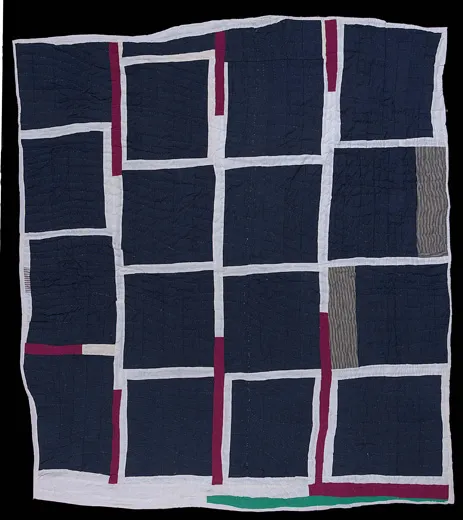
In 1941, when Pettway was in her late teens, her begetter died. "Mama said, 'I'm going to take his piece of work apparel, shape them into a quilt to call back him, and cover upward under information technology for love.'" There were hardly enough pants legs and shirttails to brand up a quilt, merely she managed. (That quilt—jostling rectangles of faded gray, white, blue and carmine—is included in the outset exhibition.) A twelvemonth later, Arlonzia married Bizzell Pettway and moved into one of the new houses built by the government. They had 12 children, simply no electricity until 1964 and no running water until 1974. A widow for more than 30 years, Arlonzia still lives in that same business firm. Her mother, Missouri, who lived until 1981, fabricated a quilt she called "Path Through the Woods" after the 1960s freedom marches. A quilt that Pettway pieced together during that period, "Chinese Coins", is a medley of pinks and purples—a friend had given her purple scraps from a clothing factory in a nearby town.
"At the time I was making that quilt, I was feeling something was going to happen better, and it did," Pettway says. "Last time I counted I had 32 grandchildren and I call back betwixt 13 and xiv great-grands. I'thou blessed now more than many. I have my domicile and land. I have a deepfreeze five anxiety long with craven wings, neck bones and pork chops."
The first exhibition featured seven quilts past Loretta Pettway, Arlonzia Pettway'due south first cousin. (I in three of Gee'due south Bend's 700 residents is named Pettway, after slave owner Mark H. Pettway.) Loretta, 64, says she fabricated her early quilts out of work wearing apparel. "I was about 16 when I learned to quilt from my grandmama," she says. "I merely loved it. That's all I wanted to practise, quilt. But I had to work farming cotton, corn, peas and potatoes, making syrup, putting upwards soup in jars. I was working other people'southward fields too. Saturdays I would hire out; sometimes I would hire out Sundays, too, to requite my kids some food. When I finished my chores, I'd sit downward and do like I'm doing now, get the apparel together and tear them and piece. And and so in summer I would quilt outside under the big oak." She fingers the textile pieces in her lap. "I thank God that people want me to make quilts," she says. "I feel proud. The Lord atomic number 82 me and guide me and give me strength to brand this quilt with love and peace and happiness so somebody would enjoy it. That makes me experience happy. I'one thousand doing something with my life."
In 1962 the U.S. Congress ordered the structure of a dam and lock on the Alabama River at Miller's Ferry, just south of Gee's Bend. The 17,200-acre reservoir created by the dam in the late 1960s flooded much of Gee's Curve's best farming land, forcing many residents to give up farming. "And give thanks God for that," says Loretta. "Farming wasn't nil but difficult work. And at the end of the twelvemonth y'all couldn't get nil, and the fiddling y'all got went for cottonseed."
Around that time, a number of Gee's Bend women began making quilts for the Freedom Quilting Bee, founded in 1966 by civil rights worker and Episcopalian priest Francis X. Walter to provide a source of income for the local community. For a while, the bee (which operated for well-nigh three decades) sold quilts to such stores as Bloomingdale'south, Sears, Saks and Bonwit Teller. Only the stores wanted assembly-line quilts, with orderly, familiar patterns and precise stitching—not the individual, often improvised and unexpected patterns and colour combinations that characterized the Gee's Bend quilts.
"My quilts looked cute to me, because I made what I could brand from my head," Loretta told me. "When I showtime I don't want to end until I finish, considering if I stop, the ideas are going to get ane manner and my mind another way, then I just try to do information technology while I have ideas in my mind."
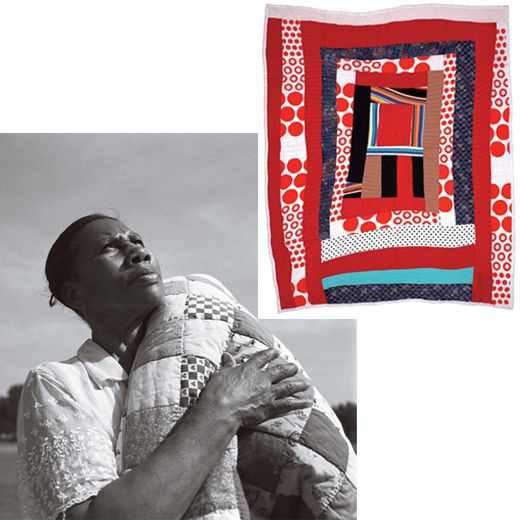
Loretta had been too ill to attend the opening of the first exhibition in Houston. Merely she wore a bright crimson jacket and a wrist corsage of roses to the opening of the second evidence last jump. Going at that place on the bus, "I didn't close my eyes the whole way," she says. "I was then happy, I had to sightsee." In the new show, her 2003 accept on the pop "Housetop" pattern—a variant of the traditional "Log Cabin" design—is an explosion of ruby polka dots, zany stripes and crooked frames within frames (a dramatic change from the faded colors and somber patterns of her early on piece of work-clothes quilts). Two other quilts made past Loretta are among those represented on a series of Gee's Bend stamps issued this past August by the U.S. Postal service. "I just had scraps of what I could find," she says about her early piece of work. "At present I see my quilts hanging in a museum. Thank God I run across my quilts on the wall. I found my way."
Mary Lee Bendolph, 71, speaks in a croaking vocalism and has a hearty, throaty express joy. At the opening of the new exhibition in Houston, she sported large rhinestone earrings and a chic blackness apparel. For some years, kidney illness had slowed her quiltmaking, only the first exhibition, she says, "spunked me to go a piffling further, to try and make my quilts a little more than updated." Her latest quilts fracture her backyard views and other local scenes the manner Cubism fragmented the cafés and countryside of French republic. Her quilts share a gallery with those of her daughter-in-law, Louisiana Pettway Bendolph.
Louisiana now lives in Mobile, Alabama, simply she remembers hot, endless days picking cotton fiber as a child in the fields around Gee's Curve. From historic period six to 16, she says, the only time she could go to school was when it rained, and the only play was softball and quiltmaking. Her mother, Rita Mae Pettway, invited her to the opening in Houston of the first quilt show. On the bus ride habitation, she says, she "had a kind of vision of quilts." She made drawings of what would become the quilts in the new exhibition, in which shapes seem to float and recede as if in iii dimensions.
"Quilting helped redirect my life and put it back together," Louisiana says. "I worked at a fast-food identify and a sewing mill, and when the sewing factory airtight, I stayed home, being a housewife. You lot merely want your kids to see you in a different calorie-free, as someone they can admire. Well, my children came into this museum, and I saw their faces."
To Louisiana, 46, quiltmaking is history and family unit. "We think of inheriting as land or something, not things that people teach y'all," she says. "We came from cotton wool fields, nosotros came through hard times, and we look dorsum and see what all these people earlier us have done. They brought the states here, and to say thank you is not enough." Now her 11-twelvemonth-old granddaughter has taken upwardly quiltmaking; she, however, does her drawings on a estimator.
In Gee'due south Bend not long ago, her bully-grandmother Mary Lee Bendolph picked some pecans to make into candy to have on hand for the children when the merely store in town is closed, which it ofttimes is. Then she soaked her feet. Sitting on her screened-in porch, she smiled. "I'm famous," she said. "And look how erstwhile I am." She laughed. "I enjoy it."
Source: https://www.smithsonianmag.com/arts-culture/fabric-of-their-lives-132757004/
0 Response to "When Was the First Exhibition of Quilt Art Shown"
Postar um comentário