Martinã¢ââ¢s Description of Participation in a Work of Art
The artist celebrates Black while interrogating historical imbalances and the roots of racial injustice
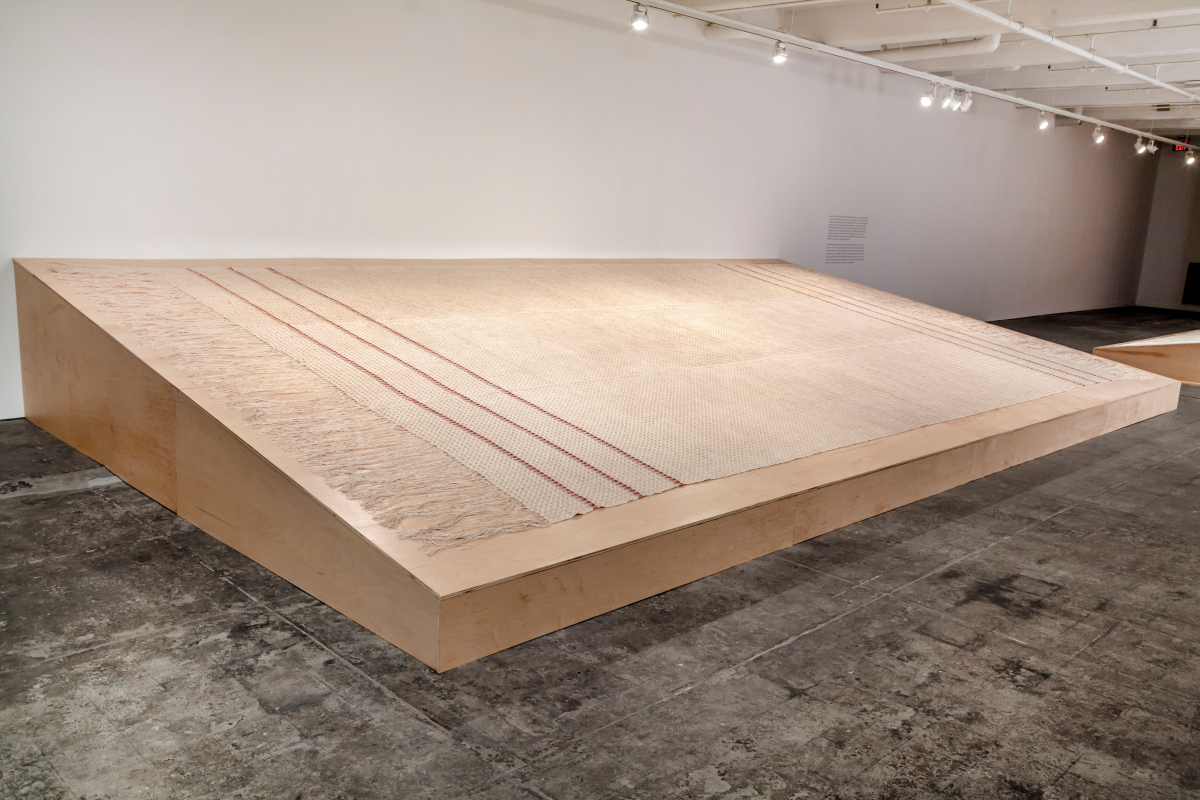
Sonya Clark, Monumental, 2019, woven linen with madder dye, 180 10 360 in., Smithsonian American Art Museum, Museum purchase. Photograph courtesy of the artist.
Sonya Clark is undoubtedly among the most historic contemporary craft artists working in the United States today.
Working in the medium of fiber—in its very broadest sense—Sonya Clark weaves stories not only in fabric and thread, only an array of materials including hair, combs, buttons, flags, and even currency. Of these, she is best known for investigating ii recurring themes—hair and flags—through which she reflects on notions of personal and collective identity, jubilant Blackness while interrogating historical imbalances and the roots of racial injustice. In her pilus works, she embeds a tenderness surrounding her own memories of girlhood braids, and pays homage to the empowerment and artistry of Black hair traditions; in her flag pieces she conveys a profound sense of the dissonance between American ethics and the realities of what it means to be Black in America today. Frequently incorporating performance and participation, Clark'due south works direct and powerfully appoint audiences in complex meditations around race, culture, gender, and class in America in ways that promote truthful dialogue on these charged subjects.
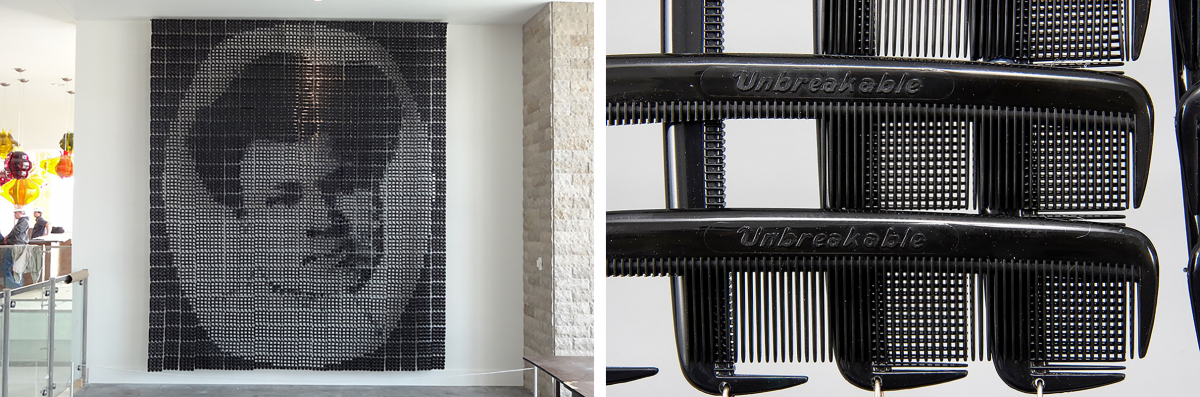
I first got to know Clark effectually 2010, through her powerful portraits of Madam C.J. Walker, which she made by carefully assembling pocket combs, removing certain tines to bring forth an image. For those unfamiliar, Walker was one of the first American women to become a self-made millionaire, and she did so by selling products designed to "tame" Blackness hair—then it both celebrates this formidable adult female, while at the same time questioning whether such hair needs to exist tamed. Since then, Clark'southward work has been included in more than 300 museum and gallery exhibitions, including a recent solo testify at the National Museum of Women in the Arts and a traveling exhibition, Monumental Cloth: The Flag We Should Know, organized past The Fiber Workshop in Philadelphia. Clark collaborated with The Fiber Workshop to create Awe-inspiring, inspired by 2 objects in the collection of the Smithsonian'southward National Museum of American History.
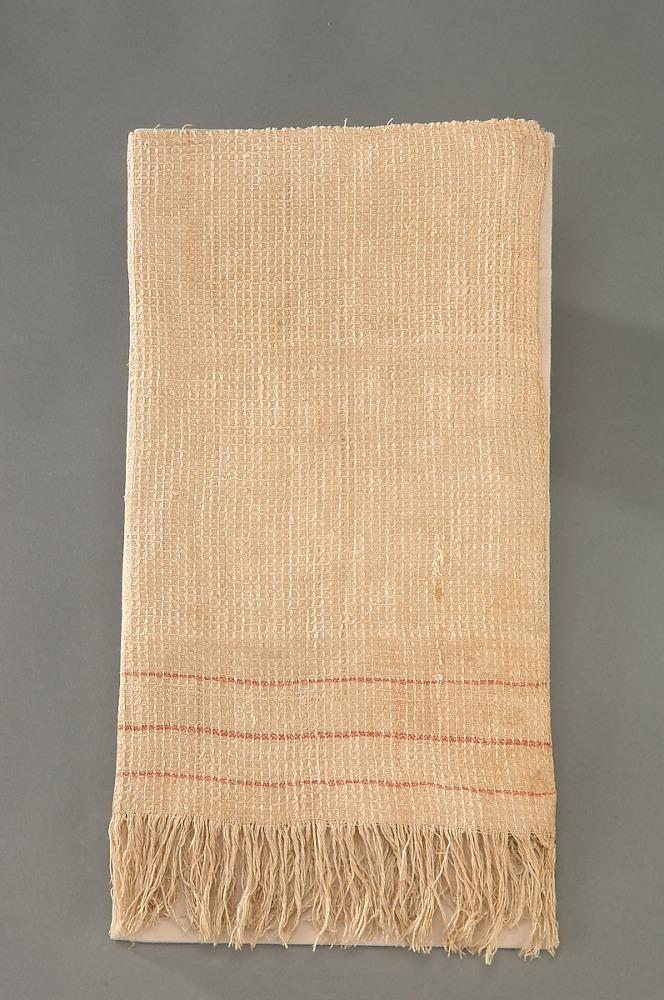
In 2011, Clark was awarded a Smithsonian Artist Residence Fellowship (SARF), which afforded her time to do enquiry for her artwork in DC, earthworks into Smithsonian collections. While exploring the galleries at the National Museum of American History, Clark came upon an unassuming dishtowel, which she discovered was the white material waved at Appomattox Court Business firm in 1865 to signal the Confederate army'southward give up. It immediately sparked in her a curiosity about why she was not familiar with this important object, when the Amalgamated battle flag is and so emblazoned in all of our minds. In response, she began to formulate a question, "What if this flag of truce was the flag we knew, instead of the Confederate battle flag?"
Following this line of idea, she fix out to recreate and recontextualize the truce flag in Monumental Textile: The Flag Nosotros Should Know. Monumental, the centerpiece of that body of work, recently caused past SAAM, is a woven replica of the truce flag enlarged to the monumental scale of fifteen feet past xxx feet, cartoon innuendo to another object in the National Museum of American History's collection, the Star-Spangled Imprint.
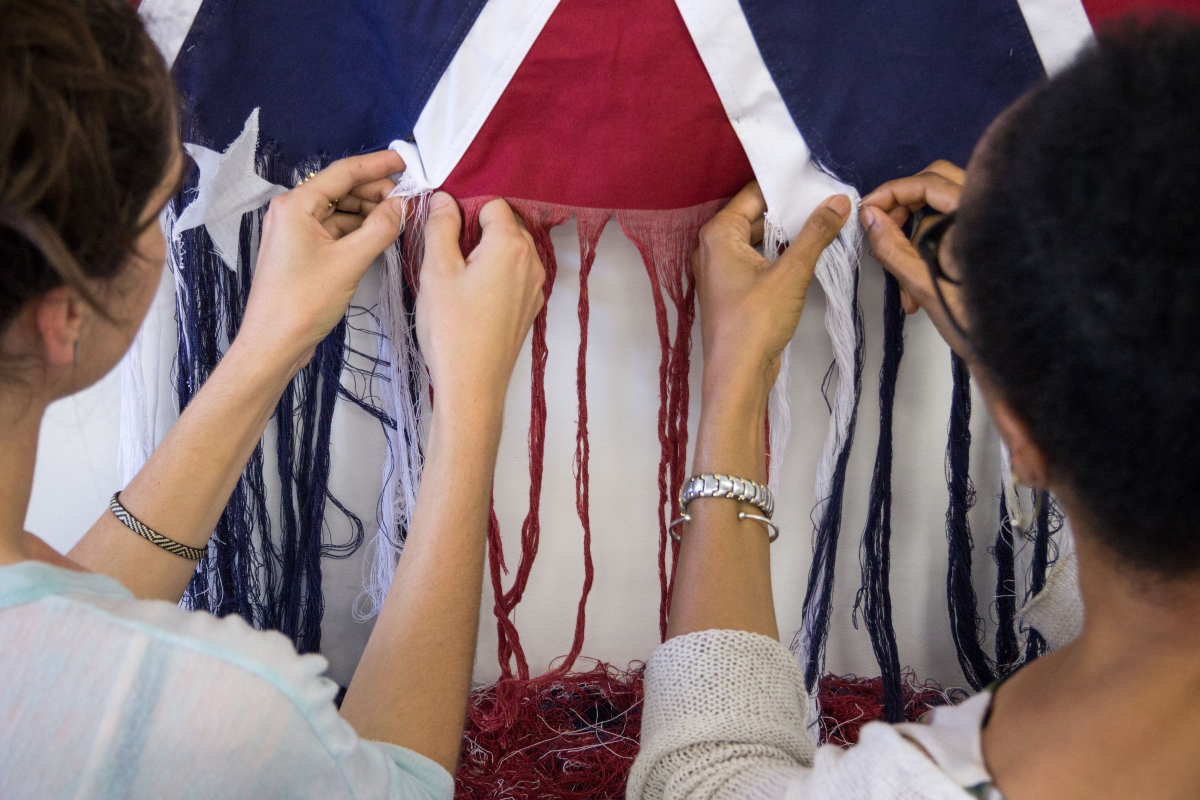
The discipline matter behind Monumental, and this larger series is an outgrowth of before projects. In some other related 'flag' piece of work, Unraveling, for which Clark gained notoriety, she and a group of participants piece of work together in a gallery performance, laboriously unweaving a commercially-produced Amalgamated battle flag while talking about their experiences. But while this project continues today, Clark noticed an interesting side-effect to its success—with every publicity epitome that appeared, the epitome of the Amalgamated battle flag was essentially beingness promulgated. Even if the point was dismantling and challenging the prototype, she realized she was actually perpetuating information technology, and that bothered her.
With Monumental, Clark sought a dissimilar strategy and the work was met with considerable national attention. Equally an article in the Brooklyn Runway describes, "While the truce flag is indicative of a desire to end the devastating Civil War, the Confederate flag is a symbol of rebellion and separation. Information technology gains power from a narrative of a wronged woundedness. This historic belief conveniently forgets the moment of truce, which was sought and brokered by Full general Lee. The dishcloth is imbued with a new sense of symbolism and worth that transcends its mere utility. It becomes unique through its newfound relationship with history. More importantly, it shows that patriotic symbols don't have the permanence that they seem to affirm, merely can be changed equally new forms of socio-cultural awareness surface. Truce is needed to acknowledge the continued trauma of a history of violence."
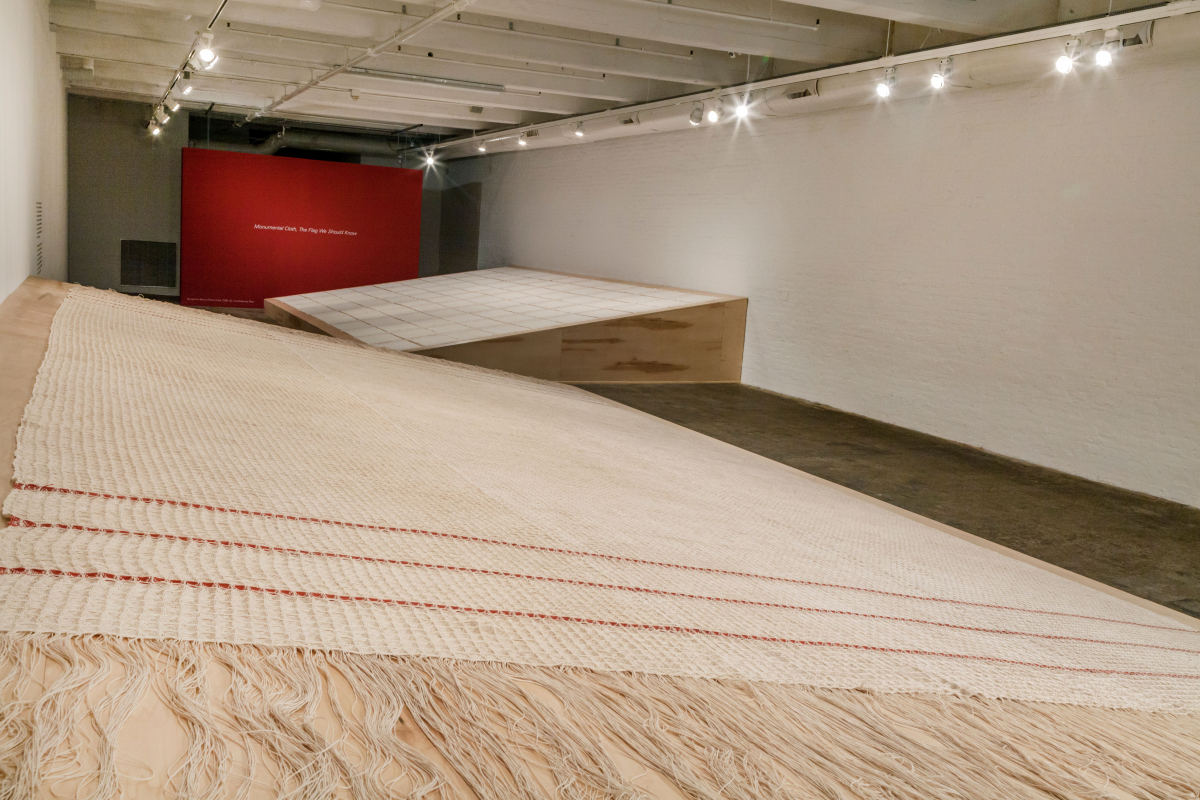
I outset saw Monumental in 2019 at The Textile Workshop in Philadelphia, when it was displayed in the exhibition, Monumental Cloth: The Flag We Should Know, and was quite taken with it. And so in the summer of 2020, when national tensions escalated in the wake of the killing of George Floyd, this work continued to haunt me. With its Smithsonian connection, and the powerful conversations information technology quietly conveyed, I felt Awe-inspiring uniquely belonged in the Smithsonian'south collection. I wrote a grant to the Smithsonian American Women's History Initiative and championed the work for acquisition with our director and Acquisitions Committee. In truth, Awe-inspiring is not an easy work on any level, and SAAM had to think long and difficult about the challenges of bringing a work of this nature into the collection. Not only does the content of the artwork elicit strong emotions, its size requires commitment to testify such a grand, fragile work. I am delighted that all were in understanding virtually the importance of this work, both inside Sonya Clark'due south career and to our nation's story.
In many ways, this work is a metaphor for where we stand as a country. Constructed using historical methods, the dirty-white surface area of Awe-inspiring physically embodies the space racial injustice holds in our collective national hidden, and as Clark notes, the act of weaving warp and weft itself becomes a powerful metaphor for bringing together two disparate sides to create a stronger textile. As a new blazon of monument in a moment when Amalgamated statues take become a wink indicate, Awe-inspiring engages audiences passionate about racial justice and invested in dialogue about the meaning and legacy of these symbols. Information technology offers a new talking betoken—the disregarded activity of truce—to this urgent conversation.
I encourage those who'd like to learn more virtually the incredible objects that inspired this piece of work to visit the Smithsonian'south National Museum of American History. Sonya Clark's Monumental will be a centerpiece in This Present Moment: Crafting a Ameliorate Earth, opening at SAAM'south Renwick Gallery May thirteen, 2022. Please come up see this and many other new acquisitions and old favorites equally we celebrate the Renwick's showtime fifty years, and look forrad to the next.
To acquire more than about Sonya Clark, watch an archived conversation between the creative person and Nora Atkinson, the Fleur and Charles Bresler Curator-in-Charge of the Renwick Gallery.
Source: https://americanart.si.edu/blog/sonya-clark-art
0 Response to "Martinã¢ââ¢s Description of Participation in a Work of Art"
Postar um comentário