How to Draw a Circle in a Cartesian Plane
 Download Article
Download Article
The familiar rectangular grid is an easy organization to acquire, but information technology is non convenient in all situations. What if you want to plot the spokes on a wheel, or the movement of water down a drain? In these cases, a circular coordinate system is a more natural fit. In fact, yous've already used the basic idea of polar coordinates in everyday life.[one] If you're locating the source of a siren, for example, you demand two piece of information: how far abroad it is, and which direction the sound is coming from. The polar coordinate system maps points the same way, describing the distance from a fixed point, and the bending from a fixed ray.


-
1
Set up the polar plane. You've probably graphed points with Cartesian coordinates before, using notation to mark locations on a rectangular grid. Polar coordinates use a different kind of graph instead, based on circles:[2]
- The centre bespeak of the graph (or "origin" in a rectangular grid) is the pole. You can characterization this with the letter O.
- Starting from the pole, draw a horizontal line to the right. This is the polar axis. Label the axis with units as you would the positive x-axis on a rectangular grid.
- If you lot have special polar graph paper, it volition include many circles of different sizes, all centered on the pole. Y'all do non have to draw these yourself if using blank paper.
-
two
Empathise polar coordinates. On the polar plane, a point is represented by a coordinate in the form :
Advertizing
-
3


Advertisement
-
ane
-
2
Measure an angle of
θ {\displaystyle \theta } -
three
Draw a line based on the sign of
r {\displaystyle r} -
4
Label the bespeak where the line and circumvolve meet. This is the point .
- The point is located on a circle with radius v centered on the pole, ¼ of the way along the circle's circumference in a counter-clockwise direction from the polar centrality. (This point is equivalent to (0, 5) in rectangular coordinates.)

Advertisement
Starting time Example Download Article
Plot the betoken P located at on the polar plane

-
1
Construct a circle with radius
r = 4 {\displaystyle r=iv} -
2
Mensurate the angle
− π 3 {\displaystyle {\frac {-\pi }{3}}} -
iii
Draw a line at this angle. Outset at the pole (origin). Since the radius is positive, movement forward from the pole through the angle you measured. The betoken where the line intersects the circle is .


Advertisement
Second Example Download Article
Plot the point Q located at on the polar aeroplane.

-
1
Construct a circle with radius
r = ii {\displaystyle r=2} -
ii
Measure the angle
3 π two {\displaystyle {\frac {three\pi }{2}}} -
3
Construct a line opposite that angle. Since the radius is negative, you must become from the pole in the reverse direction of the given angle. The point where the line intersects the circle is .


Advertisement
-
1
Consider the point
P ( 2 , ane ) {\displaystyle P(ii,i)} -
ii
-
three
Observe the angle between
O P {\displaystyle OP} -
4
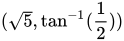
Write down the polar coordinates. You lot now have the values of and . The rectangular coordinates (2, i) convert to approximate polar coordinates of (ii.24, 26.6º), or exact coordinates of .


Advertisement
Add New Question
-
Question
How tin I calculate a vector in 3D?

Vectors in 3D are represented using the x, y, and z axes. You tin can notice their intersections and lengths just similar y'all would in 2nd vectors.

Ask a Question
200 characters left
Include your email address to get a bulletin when this question is answered.
Submit
Advertizement
-
Unlike the rectangular coordinate organisation, a point has infinite polar coordinates. For example, the indicate (1, 2π) is the same as the point (-1, π). It is likewise the aforementioned equally the points (1, 4π), (1, 6π), (1, 8π), and and so on. Each ane instructs you to "circle around" a dissimilar number of times, but they all finish up in the aforementioned identify.[3]
Thanks for submitting a tip for review!
Advertisement
Things Yous'll Need
- Paper
- Pencil
- Drawing compass
- Protractor
About This Article
Article Summary Ten
To plot polar coordinates, set up upwardly the polar plane by drawing a dot labeled "O" on your graph at your point of origin. Draw a horizontal line to the right to ready the polar axis. When y'all expect at the polar coordinate, the first number is the radius of a circumvolve. To plot the coordinate, draw a circle centered on point O with that radius. The second coordinate is an angle. Utilise a protractor to describe a line that intersects point O at that angle. The point where the circle and the angled line meet is the polar coordinate. To acquire what management to draw your line, keep reading!
Did this summary help you?
Thanks to all authors for creating a folio that has been read 51,551 times.
Did this commodity assist you?
Source: https://www.wikihow.com/Plot-Polar-Coordinates
0 Response to "How to Draw a Circle in a Cartesian Plane"
Postar um comentário