How to Talk So Kids Can Learn Chapter 1

Come across a Problem?
Cheers for telling usa well-nigh the problem.
Friend Reviews
Reader Q&A
Be the start to ask a question about How To Talk So Kids Tin can Learn
Community Reviews


It's like a applied review to How to Talk Then Kids Volition Listen Heed And then Kids Will Talk adapted for teachers and supported with plenty of stories and feedbacks from homes and schools .
Like the former one information technology focuses on the positive exact messages that help your kid to encounter himself differently and encourage the practiced behaviors.
Each chapter is summarized at the end in the course of a Quick reminder including thursday I really enjoyed my fourth dimension reading this book , fifty-fifty though it could barely bring new ideas!
Information technology's like a practical review to How to Talk So Kids Will Heed Listen So Kids Will Talk adjusted for teachers and supported with plenty of stories and feedbacks from homes and schools .
Similar the former one it focuses on the positive verbal messages that assistance your kid to encounter himself differently and encourage the good behaviors.
Each affiliate is summarized at the end in the form of a Quick reminder including the primal points and strategies to put the new learned skills in practice.
What I adore about this series are the drawings that show the common negative conversations and the positive alternative ones , here is an example :)
The frustrating conversation:
[image error]  " alt="" />" alt="" />"width="40" acme="100" alt="description"/>
A positive culling:
[image mistake] 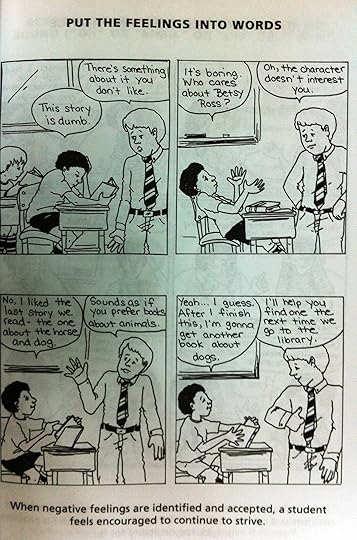 " width="xl" height="100" alt="clarification"/>
This video reminds me of the amazing Globe of kids http://world wide web.youtube.com/watch?v=WOlpdd...
...more than


I could choice up some valuable lessons from this volume, so I am very happy with the ratio of retained items per volume :).
I would recommend this for parents of kids 2+, as many times nosotros aim to use reason with kids, even thou they sympathize and feel emotions more than.
Surprisingly curt and piece of cake to absorb, every bit it'south written as a story of a fictional instructor.I could option upward some valuable lessons from this volume, and then I am very happy with the ratio of retained items per book :).
I would recommend this for parents of kids two+, as many times nosotros aim to use reason with kids, even chiliad they understand and feel emotions more.
...more than


As a someone who has worked as a carer and instructor for children, this was insightful in how to put the problem solving techniques in a pedagogy environment.
This one, though following similar messages and lessons, was adjusted well for the schooling setting, included new cartoons, reminders and equally always, my favourite, the anecdotes. And the old repetitions were revamped and sub
Me gusta! v/5 I loved all the books I've read by them so far and deceit look to read the adjacent ( Siblings without Rivalry).As a someone who has worked equally a carer and teacher for children, this was insightful in how to put the problem solving techniques in a teaching environment.
This one, though following similar messages and lessons, was adapted well for the schooling setting, included new cartoons, reminders and as ever, my favourite, the anecdotes. And the old repetitions were revamped and subtly inverse to match a teacher's perspective while holding the core values.
My favourite affiliate was "How to complimentary a kid who is locked in a role" as I identified well with it and could see how if I had had adults around me apply this lessons I may have benefited greatly in the past.
And I plant the mixed in parental anecdotes meshed well aslope teacher's experiences and the "parent teacher relationship" chapter was very of import and helpful to me equally well.
I could definitely await back at certain behaviours that I had in myself when teaching and run into a different way of approaching the effect.
These are very important books, I would recommend to all, to be honest, as they help you in your life skills. We gotta work on modeling ourselves to be able to deals with relationships, conviction, bug and conflicts and I feel that this series of books really exercise them justice.
I'grand going to pass this on to friend and swain teacher and I tin just promise she enjoys and can implement some lessons to enrich her instruction experience.
...more
I love Alfie Kohn'southward ideas nearly fugitive punishments and rewards, simply his books (at to the lowest degree the ones I've read) are pretty heavy on theory and pretty lite on applied awarding. Faber and Mazlish offer heaps o
This book was shelved with the homeschooling books at the library, and although it'southward not specifically geared towards homeschoolers, it has a lot of bang-up suggestions that I think will exist useful to the homeschooler oversupply (besides as teachers and parents of children going to school-schoolhouse).I dear Alfie Kohn's ideas about fugitive punishments and rewards, only his books (at least the ones I've read) are pretty heavy on theory and pretty low-cal on practical application. Faber and Mazlish offer heaps of real-world examples that I've been able to try out immediately with my own kiddos. I would honey to accept a conflict resolution workshop at my kids' homeschool co-op based on the ideas in this volume (only in case whatever of my swain co-op parents are reading this, I want to attach an emphatic "Not it" to this proffer).
The merely affair this book lacks is a chapter on what to practise when your nine-yr-old has read the volume ahead of yous and is at present correcting your technique when y'all try to implement the suggestions. (This shared reading also led to an interesting chat with my daughter that began, "Mom, in one affiliate they imply that saying 'your mother' is an insult, and I can't figure out why that would exist an insult.")
...more

- How to bargain with feelings that interfere with learning
- Tips that invite kids to cooperate ( particularly helpful if you lot are not disciplinarian)
- Alternatives to punishment that lead to cocky subject area
- Problem solving that appoint child'south creativity and commitment
- How to praise and criticize in a constructive
- How to deal with feelings that interfere with learning
- Tips that invite kids to cooperate ( especially helpful if you lot are non authoritarian)
- Alternatives to punishment that pb to self bailiwick
- Problem solving that engage child'southward creativity and commitment
- How to praise and criticize in a constructive way
- How to free a kid who'south locked in a part
- parent-teacher relationship
I plant the book very helpful.
...more than 


Children demand to have their feelings best-selling
Child: "Only considering of a few careless mistakes, I got only a 70!"
Developed: "Don't worry. You'll do amend next time".
Instead of dismissing the child'due south feelings, you can:
ane. IDENTIFY THE CHILD'S FEELINGS
a. "You lot sound disappointed. It can be upsetting when you know the reply and lose points for
Children need to have their feelings best-selling
Child: "Just because of a few careless mistakes, I got only a seventy!"
Developed: "Don't worry. You'll exercise amend next fourth dimension".
Instead of dismissing the child's feelings, y'all can:
1. IDENTIFY THE Child'Due south FEELINGS
a. "You sound disappointed. It tin can be upsetting when yous know the respond and lose points for careless mistakes".
ii. Acknowledge THE Kid'south FEELINGS WITH A Audio OR WORD
a. "Oh" or "Mmm" or "Uh" or "I see"
iii. Requite THE CHILD IN FANTASY WHAT YOU CAN'T GIVE HIM IN REALITY
a. "Wouldn't it be great if you lot had a magic pencil that would stop writing if you lot were near to make a mistake."
4. Have THE Kid'S FEELING Fifty-fifty Every bit YOU STOP UNACCEPTABLE BEHAVIOUR
a. "Yous're still angry virtually that form, you're kicking your desk! I tin can't let that. But you tin can tell me more about what's upsetting you. Or you tin can draw it."
Engaging Cooperation
Adult: Who is responsible for the mess on this floor?
Instead of questioning and criticising, you lot can:
1. Describe THE Problem – When it happens the commencement time
a. "I see moisture paint all over the floor"
two. GIVE Data – When the kid does not know this for a fact
a. "It'southward easier to remove paint before it dries"
3. OFFER A Choice – When the child does non accept immediate action
a. "You tin can clean information technology upwardly with a wet rag or a damp sponge."
four. SAY IT WITH A Discussion OR GESTURE – When this repeats
a. "The paint!"
5. Depict WHAT Yous Experience – When it repeats also many times
a. "I don't similar seeing the floor splattered with paint".
6. PUT It IN WRITING – When it repeats too many times
a. Attending ALL ARTISTS: Kindly restore the floor to original condition earlier leaving the room. Thank yous, The Management
7. Exist PLAYFUL (Use another voice or Emphasis) – When the kid responds to this technique
a. In a country-and western manner sing
i. Ah meet paint thar on the flooring,
ii. An' it's a sight ah practise deplore
iii. Git out your mop an' rags galore
four. An' help to do this little chore
Alternatives to Punishment
Kid: Oh !@#%^#%@^% I can't do math
Developed: I warned you over and over again not to use foul language. Now you're going to be punished.
Instead of threatening punishment, you can:
1. Betoken OUT A WAY TO Be HELPFUL
a. "I hear your frustration. It would assist if you could express it without blasphemous"
2. EXPRESS YOUR Stiff DISAPPROVAL (WITHOUT ATTACKING, Grapheme)
a. "That kind of language upsets me".
3. Country YOUR EXPECTATIONS
a. "I expect you lot to find some other fashion to let me know how angry you are"
4. SHOW THE CHILD HOW TO MAKE AMENDS
a. "What I'd like to run across is a list of some strong words yous could use instead of the ones you lot just did. Try the lexicon or thesaurus if you need aid"
5. OFFER A Option
a. You tin can expletive to yourself – in your caput – or you can utilize words that won't offend anyone.
half dozen. Allow THE CHILD EXPERIENCE THE CONSEQUENCES OF HIS BEHAVIOUR
a. "When I hear those words, I lose all desire to assist you – with math or annihilation else".
Problem Solving
1. LISTEN TO THE Child'South FEELINGS AND NEEDS.
a. Adult: You seem very upset about failing your Castilian test.
b. Child: I am! I just got twelve words right out of twenty, and I studied for an hour last night!
2. SUMMARIZE THE Kid'South POINT OF VIEW
a. You lot audio pretty discouraged. Even though you tried to cram all those new words into your head, some of them refused to stick.
3. Express YOUR FEELINGS AND NEEDS
a. My concern is that if yous don't memorize the basic vocabulary, you lot'll get further and further behind.
4. INVITE THE Kid TO BRAINSTORM WITH Yous
a. I wonder if we put our heads together, could we come upwardly with some new and more constructive ways to study?
5. WRITE DOWN ALL THE IDEAS – WITHOUT EVALUATING
a. Kid: Drop Spanish
b. Developed: I've got that. What else?
c. Child: Maybe I could …
6. TOGETHER DECIDE WHICH IDEAS You lot DON'T Similar, WHICH YOU Practise, AND HOW YOU PLAN TO PUT THEM INTO ACTION
a. Adult: What do you call up of making flash cards and studying only four new words each night?
b. That'south okay. Simply instead of wink cards, I like the idea of saying my words into a tape recorder and testing myself until I know them.
Helpful Praise/Constructive Responses
Child: Listen to my poem about a train. Tell me if information technology is proficient
Adult: Beautiful! You're a neat poet.
Instead of evaluating, you can:
1. DESCRIBE WHAT YOU SEE.
a. "You lot defenseless the 'chug-a-chug' rhythm of the train and y'all institute a way to rhyme 'track' with 'clickity-ballyhoo'"
2. Depict WHAT YOU FEEL
a. "It makes me feel as if I'one thousand sitting inside a railroad car speeding through the countryside.
Adult: Await at those misspelled words! You tin do improve than that.
Instead of criticising, you lot tin:
3. Betoken OUT WHAT NEEDS TO BE Done
a. "All this poem needs now is the correct spelling of the words 'caboose' and 'freight' and information technology's ready for bulletin board"
Freeing a child from playing a role
Adult: "Nicole, you're a "motor mouth". No i can get a give-and-take in edgewise with yous".
Instead of labelling a child, you lot tin:
ane. Await OUT FOR OPPORTUNITIES TO SHOW THE CHILD A NEW Movie OF HERSELF
a. "What self command! Even though you had a lot more to say, you realised that others needed a run a risk to talk."
2. PUT THE Child IN A SITUATION WHERE SHE CAN SEE HERSELF DIFFERENTLY
a. "Nicole, I'd like to you lot to chair the (form/family) meeting and brand sure that anybody gets a turn to speak".
3. Permit THE Kid Eavesdrop You lot SAY SOMETHING POSITIVE Virtually HER
a. "Nicole has so many wonderful ideas that it is difficult for her to concord back. Nevertheless I've seen her do information technology"
iv. MODEL THE BEHAVIOUR YOU'D Like TO SEE
a. "Oh, I am sorry. I didn't mean to interrupt. Please finish what you were proverb. My though will proceed".
v. REMIND THE Child OF HER By ACCOMPLISHMENTS
a. "I think the discussion nosotros had on death penalty. You listened quietly, merely when you finally gave your views, some people changed their positions".
6. Land YOUR FEELINGS AND/OR EXPECTATIONS
a. "Nicole, when other people are waiting to speak, I'd like you to keep your comments brief".
The Platonic Briefing (PTA)
Instead of starting with what's wrong …
1. START By DESCRIBING SOMETHING RIGHT
a. Teacher: I enjoy Sam's thoughtful questions
b. Parent: Sam liked the lesson you gave on rockets
Instead of pointing out what the child hasn't washed …
2. Depict WHAT THE Child NEEDS TO DO
a. Teacher: Sam needs to make upwards all the piece of work he missed the week he was out sick.
b. Parent: I think he's feeling overwhelmed. He can probably utilise some extra help to catch upwards.
Instead of withholding data …
three. SHARE PERTINENT Data
a. Parent: He used to play outdoors when he got habitation. Now he just sits in front of the TV.
b. Teacher: I run across him yawning a lot lately in the class
Instead of giving each other advice …
4. DESCRIBE WHAT HAS WORKED AT Abode OR IN SCHOOL
a. Parent: Ever since he's been ill, he seems to do meliorate if he takes a short break every xv or twenty minutes.
b. Teacher: I discover he has more energy after recess.
Instead of giving up on the child …
v. DEVELOP A PLAN TOGETHER
a. Teacher: I'll ask some other student to aid Sam with the piece of work he missed. And I'll see to it that he takes more frequent breaks.
b. Parent: And I'll brand sure he watches less TV and gets some fresh air and practise.
Instead of ending on a negative note …
half dozen. End THE CONFERENCE WITH A POSITIVE Statement THAT Can BE REPEATED TO THE Child
a. Teacher: Tell Sam I take conviction that he'll exist able to brand up his work. As well tell him that I savor having him in my class.
b. Parent: I volition. I know he'll be glad to hear that.
Instead of forgetting the program after the conference …
7. FOLLOW THROUGH ON THE PLAN
a. Instructor: Jeffrey has been helping Sam and he's almost all caught upwards. He also seems to have more than energy lately.
b. Parent: My husband has started jogging and Sam has been joining him.
Some Excerpts
1. "The plain fact is that when students are upset, they tin't concentrate. And they certainly tin't absorb new material. It we want to gratuitous their minds to retrieve and acquire then nosotros have to deal respectfully with their emotions."
2. Practice not be over begetting or pamper the child. A mother "Well … when Lara comes home from school, I make her show me her assignments and I get over them with her and help her get organized. This afternoon I took her to the library and nosotros picked out some first-class books for her written report on Eleanor Roosevelt" Teacher was horrified and thought to herself, Lara is a reasonably capable student. The purpose of my homework assignments was to give her and the other children a chance to organize their ain time, to work independently, to do their own judgement. Every bit tactfully as she could, she said "It seems to me that the best kind of help we tin can requite children is indirect assistance. Provide a tranquility identify to piece of work, a good light, a dictionary, a snack if they are hungry, and simply be available if they want to inquire you something.". The mother was unconvinced. So the teacher suggests "How would you lot experience about establishing a nightly routine with Lara? She could either work alone in her room or maybe somewhere virtually yous, and little past petty you could brand yourself scarce and let Lara take over." "I wish it were that elementary," Lara's mother said with some irritation. "but the plain fact is, she won't do her homework if I don't go on afterward her. She ". "Please don't take offense" another woman interrupted "only I don't think you're beingness fair to your daughter. My mother used to hound me almost my homework every night and hover over me to make sure that I did information technology all and got information technology right. Sometimes she'd have over and practise it for me. Afterwards a while I wouldn't even start my homework unless my mother was there. I guess on some level I figured that as long she was being responsible for me, I didn't have to exist responsible for myself. So that'south my reason for having a "hands-off" homework policy with my daughter." Lara's mother looked bewildered. "You mean y'all never help your child with her homework?" "Well if she's stuck, I'll listen to what's bothering her and try to get her unstuck. Merely the 2d she gets going again, I bow out. I want her to know what she's the one in accuse of her homework and that she's basically CAPABLE OF DOING Information technology HERSELF". "That's bold she is" Lara's female parent persisted. "Only what if she isn't?". Without hesitating the woman blurted out "Then get outside help – a tutor, a loftier school educatee – or tell her to call another kid in the course. Anything to avert what happens when parents take over and become 'passionate' about their children's homework".
3. When nosotros invite a kid to join us in tackling a problem, we ship a powerful set of letters:
a. "I believe in you"
b. "I trust your ability to call back wisely and creatively"
c. "I value your contribution"
d. "I see our relationship not every bit 'all powerful grown-up' exercising authority over 'ignorant child' but as adult and child who are equal, not in competence, not in experience, but in equal dignity".
east. "If in that location is one thing nosotros tin guarantee all of our children, at present and in hereafter, it's problems – sometimes 1 right after the other. But by teaching them how to approach a problem, past showing them how to intermission it down into manageable parts, by encouraging them to use their ain ingenuity to resolve their problems, we are giving them skills they tin can depend upon for the rest of their lives."
4. Ane way to avoid blame is to shun the accusing you lot. "You lot kids never … Y'all always … The trouble with you is … " Instead substitute I for a you lot. For example "Here'south what I feel. I get upset when … What I'd similar to see is …" As long equally they are not beingness attacked, children can heed to your feelings without condign defensive.
5. We need to treat children not as they are, simply equally we promise they will go.
Another must read for all the parents.
...more


It is nearly indistinguishable of her How to Talk so kids volition mind, but give more concrete examples in the school.
Chap1: How to deal with feeling that interfere with learning
Children need to have their feelings best-selling at home and in School. p43
"... If we're to take whatsoever hope of helping them principal their academic skills, we accept to help then unpack some of the emotional baggages they carry into our classroom. That means our role as teacher has to change to include many elemen
It is almost duplicate of her How to Talk then kids will listen, but give more concrete examples in the school.
Chap1: How to deal with feeling that interfere with learning
Children need to have their feelings acknowledged at habitation and in Schoolhouse. p43
"... If we're to have any hope of helping them main their academic skills, we have to assist and then unpack some of the emotional baggages they deport into our classroom. That means our role as instructor has to modify to include many elements of parenting. p60
Chap2: Seven sills that invite kids to cooperate
Kids telephone call out their answers without raising their easily.
Roses are red
Lettuce is light-green
If you enhance your hand
It will be seen.
i. Depict the problem
two. Requite information
3. Offer a choice
4. Say it with a word or gesture
5. Describe what yous experience
6. Put it in writing
7. Be playful (use another voice and emphasis)
Chap 3. The pitfalls penalization
1. point out a manner to exist helpful
ii. Express stiff disapproval (without attaching character)
three. State your expectation
4. Evidence the child how to make amends
5. Offer a option
half dozen. Have action
vii. Allow the child to feel the consequence of his misbehaviour
p102 I want to know how to achieve within my students and turn the "desire to misbehave" into "desire to acquit appropriately. I wanted to avoid the terrible fallout of punishment and encourage the children to be inner-directed and cocky-disciplined. I wanted to observe some effective alternatives to punishment.
Advocate of punishment p100 -102
Penalty and Its Alternatives: A New Perspective for Behavior Modification by Johnny L. Matson
Applied Beliefs Analysis by John O. Cooper
Oppose of penalty
Teacher and Child by Haim Ginott
Reading, Writing and the Hickory Stick: The Appalling Story of Concrete and Psychological Abuse in American Schools by Irwin A. Hyman
Maintaining Sanity in the Classroom by Rudolf Dreikurs
others p114
Punished Past Rewards: The Trouble with Gilt Stars, Incentive Plans, A's, Praise and Other Bribes by Alfie Kohn
Chap four. Solving problems together: six steps that appoint children'southward creativity and commitment
1. Listen to the child's feeling and needs. (you seem very upset about declining your test)
2. Summarize the child'southward points. (You audio pretty discouraged, Even though y'all tried.)
3. Express your feeling and needs.(My concerns is that if you practice not ..., y'all'll get further and further behind.)
4. Invite the kid to brainstorm with you ( I wonder, if we put our heads together, could we come upwardly...)
5. Write down al ideas - without evaluating
vi. Together decide which ideas you don't like, which you do, and how you lot programme to put them into activeness.
Chap 5: Praise that doesn't demean, criticism that doesn't wound
Instead of evaluating, you can
ane. Describe what you see or here
2. Describe what you experience
Instead of criticizing, you can
3. Points out what needs to be done.
p181 Praised that creates dependency upon the approving of others (a perfect report card. I'm so proud of you)
Praised that gives a child a sense of his ain abilities and achievement (There A's represent determination and hours of hard piece of work. Y'all must be proud of yourself.)
p189.. Every answer on this paper is correct. You actually understand decimal points. Statement similar these assistance a students to measure himself by his own standards rather than confronting his classmates' performance.

Dear the comics, the examples, and the format of the volume (existence told in a mixture of how-to and narrative format) was effective. Some of the stories where the teachers implemented these strategies and the kids' behaviour improved were super inspiring. The questions from parents/teachers section was great to give more examples and clear up defoliation. Every bit usual, the authors were super organized and the book structure was exqu
Just similar every other book in the 'How to Talk' series, this was amazing!Love the comics, the examples, and the format of the volume (being told in a mixture of how-to and narrative format) was effective. Some of the stories where the teachers implemented these strategies and the kids' behaviour improved were super inspiring. The questions from parents/teachers department was great to give more than examples and articulate up defoliation. As usual, the authors were super organized and the book structure was exquisite.
Involving ii teachers in the writing of the volume was great - you get Faber & Mazlish'south expertise as well as Lisa & Rosalyn's experiences besides.
Of import pages:- What'due south Worrying Anthony (49)
- Funny stories - Max (pro-puree) and Tommy (and the principal) (92)
- Written report in writing most a conflict (124-125)
- Dealing with a child in silence (126)
- Darryl's story (226-228)
- Parent instructor interviews summary (241)
Important concepts:
- When negative feelings are identified and accepted, a student feels encouraged to continue to strive (29)
- When teachers draw the problem, instead of accusing or giving commands, students are more willing to behave responsibly (68)
- Kids don't demand "another demonstration of how bigger, stronger people can hurt smaller, weaker people... If we wish to teach kindness, we must use methods that are kind. A child who is cruel to some other child needs to experience the force of your convictions, not the pain of a paddle. He needs to hear a stern 'I don't similar what I see! No ane should exist teased to tears - e'er!' He needs to hear your expectations of him: 'I await kindness from you, and you can start right now by returning the glasses.' Respect for others tin can only be taught respectfully." (123)
- Instead of pointing out what hasn't been done, describe what has been done and what needs to be done. Example: Instead of "You lot nonetheless haven't done the last 2 problems! At the rate you're going, you'll never finish", say "You're more than than halfway through! Three problems done and simply two more to go!" (177).
One of the few, few, FEW things I wasn't sure I totally agreed with was the 'descriptive praise'. While I think this is a good thought, I know as a kid if my parents said,
"I see a black sky and a stake moon and bright yellow stars" (172) about my picture, I wouldn't have felt like they were praising me- more than that they were present/aware. Because the argument is quite neutral, it feels like it's missing the positive element.
At present, there are skilful examples they gave in the volume of how to use descriptive praise, including:
DON'T
Child: "Expect, I'm all washed!"
Teacher: "Expert male child!"
Do
Child: "Wait, I'yard all done!"
Teacher: "You full-bodied on your work and didn't stop until you were finished." (173)
On the praise point, I was thinking it would be nice to have adults using positive quality/trait adjectives (due east.g. caring, responsible, etc.) for the kids. The authors did address this:
"Whatever kind of blessing can feel good for the moment. But if you desire these words to go inside a child and remain there, you need to follow/precede them with a description...
e.g. 'You knew I'd be worried if y'all weren't home when I got dorsum from work, so you left me a notation with a telephone number where I could reach you lot. That's what I telephone call beingness considerate.'...
In each case you lot are pointing out a unmarried instance in which a child has been creative or honest or creative. There is no pressure for him to always be that mode." (182)
My only other criticism is that it would have been squeamish to have page numbers on the comics pages; it's difficult to mark certain pages to render to when there are no folio numbers.
This book was and then proficient, I would like to buy it. (And equally big of a reader I am, I rarely purchase books).
I would recommend to anyone/anybody - whether you're a teacher, parent, someone who works with kids, etc.
...more than
"Equally teachers our goal is greater than only passing on facts and information. I
This is, hands downward, the best book on teaching and dealing with kids that I have ever read! (full notes to come up). I rarely write notes downward and post them on goodreads simply this book is worth an exception. I hope these notes might come in handy to some people. I take been writing this notes for days at present so hopefully I can finish it in the side by side twenty-four hours or two. There are too many things to absorb and so my notes might be untidy.."Every bit teachers our goal is greater than just passing on facts and information. If we want our students to be caring human being beings, then we need to respond to them in caring ways. If we value our children's dignity, then we demand to model the methods that affirm their dignity. If we want to send out into the world young people who respect themselves and respect others, then we demand to brainstorm by respecting them. And we can't do that unless we show respect for what it is they feel" "The sad truth is that in today's globe, kids are being subjected to unprecedented stress and neglect. If we're to have whatsoever hope of helping them main their academic skills, we have to help them unpack some of the emotional baggage they behave into our classrooms." "Our role as educators is not to supply right answer to but assistance children arrive at answers through their own thinking process"
i. acknowledge kids' feelings, make them experience understood "to find… must be a big daze and disappointment". Give in fantasy "wouldn't it exist great if y'all could zip upward to the top". Have feelings even as you cease unacceptable behavior "afterwards in .. yous can show me…". Timing is also very of import when it comes to teaching someone something (when a person is drowning, it's non the time to give swimming lessons) "information technology tin be upsetting to lose.. do you think u might accept left on the motorbus?". Accept and reflect feelings and wishes "oh,; i forget-u wish u didn't". "You're kicking. I can't allow that. Just u can tell me abt what's upsetting u, or u tin can depict it". "Information technology can be frustrating when… it makes u want to rip and throw things. when yous feel like that, say "I'g frustrated, tin can u help me? and so we tin can figure sth out together". When a child is in emotional turmoil, they can't hear you. Best selection is later on they accept been heard out, u can requite them pick to take, explore ur suggestion "Do u think it would assistance if.."; "How would u feel abt..?"; "I bet if u were the instructor, u'd declare a vacation every one time in a while"; for a kid who doesnt want to talk, let them know we're there for them if they change their minds. Write downwards kids' worries, put under pillow. "I hear a boy who absolutely hates the idea of wearing… and that is the worst matter.." We demand to make a clear distinction btw feeling and behavior ". When dealing with students from dysfunctional family, say "I didnt similar what I just heard, if u're angry, tell me in another way, and I'll be glad to listen". Never utilise just… "You miss ur mom? It's hard to… maybe we tin brand a moving-picture show of ur mom"; "Oh that's what fabricated u made. I bet now that J knows u don't like, he wont practise it again. Maybe u demand some time apart b4 u can be friends again"
2. Describe the problem "there'south some paint on the floor. You can be heard down the hall// finish". Requite information "desks are non for writing on". Offer a option "it'south hard to.. Do y'all desire to call back abt information technology some more or do u want to talk information technology over with me?. Ss dislike listening to lectures or long explanation. A single give-and-take or gesture encourages them to think abt problem. Describe what u feel (make no reference to the ss's character) It hurst my back when ppl hang on me. I didnt like hearing that my course gave the substitute a hard time. Put information technology in writing and stick it in noticeable places. Kids are quick to reply to anything that'southward playful (brand a train to go to..u are engine.. the remainder are freight cars) (take the magic keys out of their pocket, lock their rima oris and hand me their keys b4 walking out the door). Try using another vocalisation or emphasis, be some other graphic symbol (gangster, belle..). describe prb-i hear answers, i dont see hands -> desribe feeling -deplorable ->offer pick - right left hand. tone of voice is important equally words "I have conviction in ur ability and ur judgment. once i bespeak out the problem, u'll know what to practice". "S is very upset. some pages were torn. if anyone in this fam runs out of papers, inquire me and i'll help u find some". "The thought of standing upward and giving a speech tin can be scary. Even pro get nervous. What do u think would make u feel more relaxed? practicing ur talk in front of a mirror?" Instead of telling ss what to exercise, direct their attending to the problem and then that they can tell themselves what to exercise. "I care abt how I experience. I care abt how you feel. And I expect this to be a class where we all care abt each other'due south feelings". "You might wish u could stay out for the rest of the forenoon. Well, it's time to get dorsum to course at present. What do u say? should we go in this door or that door?"
3. Alternatives to punishment. Signal out a fashion to be helpful - I hear ur frustration. It would be helpful if u could limited information technology without blasphemous. Limited ur stiff disapproval - that kind of language upsets me. State ur expectations - I expect u to find some other way to let me know how angry u are. Show the kid how to make amends - what I'd like to see is a list of some strong words u could utilize instead of the ones u just did. Attempt the dic if u need help. Offer a pick - u can curse to urself - in ur head- or u can use words that wont offend anyone. Let the ss experience the consequences of his behavior - when I hear those words, I lose all want to help u -with math or anything else. Alternative to time-out corner - "I can see you're still angry at J. DO u want to tell me abt it or do u want to use the paper and crayons in the absurd-off corner to draw how u feel?". Dealing with bully - "I dont like what I see. No one should exist teased to tears. I expect kindness from u, and u can kickoff right now by returning..". When solving disharmonize, "Let them write, read their written report, inquire them to share recommendation with each other and come up to an understanding"
4. Solving problems together: engage ss' creativity and commitment. Listen to ss' feelings and needs (I observe that .. I'd similar to know how u feel abt that). Summarize their point of view (So you're telling me that when….) write on board. Limited ur feelings and needs (I get upset when I hear anyone beingness put downwards. I believe ppl should hear each other out - with respect - whether they agree or not. Invite the class to begin with u to find a solution (I'1000 wondering whether we can think of anything we can do, every bit a class, to terminate cutting each other off). Write downward all ideas - without evaluating. Together make up one's mind which ideas u dont like, which u do and how u plan to put them into action (Instead of putdowns -> Use respectful talk). Substitute an I for an you (here's what I feel. I get upset when.. What I'd similar to encounter is.) (Let'southward non blame each other for what happened in the by. What we all need to think abt now is a solution for the time to come)
v. Praise that doesnt demean, criticism that doesnt wound. Instead of evaluating, describe (I see a …The instructor told me u plant a wallet and returned information technology. Yous concentrated on ur work and didnt stop until u were finished. Y'all marked all ur information points, connected them with a straight line). Draw what has been done and what needs to exist done (You're more than halfway through. Three problems washed and only two more to become) ~ a beautiful quote: "In my perfect universe nosotros would all be there for one another, property up a mirror to i another's efforts and accomplishments so that we could all feel visible and valued". Requite objective annotate (I run into how u managed to add together up this long column of figures and become the correct answer. It's because u were careful to put one number directly under the other) and it'southward all-time to save emotional response to one ss for a more private moment.
...more A mutual strategy throughout the tactics presented is to acknowledge emotions. I observe information technology interesting that they didn't call this out explicitly.
Use descriptive praise (instead of evaluative praise) to enable the child to praise themself. The examples of descriptive praise in the book come beyond as hollow, probably because they're frequently juvenile.
The six footstep problem solving appr
Practical and easy to digest. It uses a narrative form simply brings in research and addresses common misconceptions.A common strategy throughout the tactics presented is to admit emotions. I notice it interesting that they didn't call this out explicitly.
Use descriptive praise (instead of evaluative praise) to enable the child to praise themself. The examples of descriptive praise in the book come across as hollow, probably because they're frequently juvenile.
The six step problem solving approach is a good formalization of the rough process I use already, even with adults.
I work with kids in not-formal education as a volunteer, then some of this applies and some doesn't. I think that reading How to Talk to Kids Volition Listen in a twelvemonth or so would be a slap-up refresher and unlike take on the aforementioned topics.
...more

Some other bang-up book on talking to kids by Faber and Mazlish. I actually appreciate the authors' recognition of the struggles parents and teachers confront when trying to get through to kids, who are themselves trying to be contained from adults. Highly rec
2019 Update: Yes, lots of examples and vocabulary are dated. Yes, it'south even so valuable. Particularly capeesh the reminder to always admit feelings before starting in on solutions, and to give descriptive praise. Hither comes another schoolhouse year!Another corking book on talking to kids by Faber and Mazlish. I really capeesh the authors' recognition of the struggles parents and teachers face up when trying to get through to kids, who are themselves trying to exist contained from adults. Highly recommend this book to parents and teachers, though rereading the original How to Talk And so Kids Volition Listen and Listen So Kids Will Talk might do just every bit well. This volume features the same principles with classroom examples.
...more
In the end at that place is a section on how parents and teachers shoul
Love the format of narrative shaped through a immature teacher's journeying in gaining confidence and also battling old school assistants and teachers. The volume effectively uses multiple mediums to drill in information technology'due south primal points through the story line, illustrations, A Quick Reminder, Questions from Parents, Stories from Parents, Questions from Teachers, Stories from Teachers. The narrative of story reminds me of Eliyahu Goldratt's The Goal.In the end there is a section on how parents and teachers should collaborate for the benefit of the kid, and also a reminder on the other'southward perspective.
This book was magical. A tantrum child suddenly started nodding at my words amid her sobs. I am grateful.
...more


Related Manufactures

Welcome back. Just a moment while we sign y'all in to your Goodreads account.

Source: https://www.goodreads.com/en/book/show/829768
0 Response to "How to Talk So Kids Can Learn Chapter 1"
Postar um comentário